
MENU
As we approach the Autumn Equinox, I find myself returning to the ancient Greek story of Demeter and Persephone. Although I have known something of the myth for many years, it was during my journey to Greece last September that I heard the story of Demeter told in its fullness for the first time.
One moment in particular has stayed with me: Demeter's sacred, defiant No. And alongside it, a realisation that seems remarkably simple, yet has opened something much deeper for me — without the harvest, there is no offering. For how can gratitude be offered through ritual if there is nothing to say thank you with?
And so, I find myself wondering what this ancient story might be saying to us about harvest, gratitude, reciprocity and our relationship with the living world.
The Autumn Equinox marks a moment of balance in the turning year, when day and night are almost equal and we stand at the threshold of the darker half of the year.
I have always been fascinated by these in-between places. They invite us to pause — not because the journey has stopped, but because for a moment we become more conscious of where we are within it.
There is something valuable in simply noticing: Where have I come from? Where am I now? Where am I going?
Autumn makes this movement wonderfully visible. The light is changing, leaves are turning and the natural world around us is responding to the season. We too can take a moment to recognise the transition — before continuing onwards.
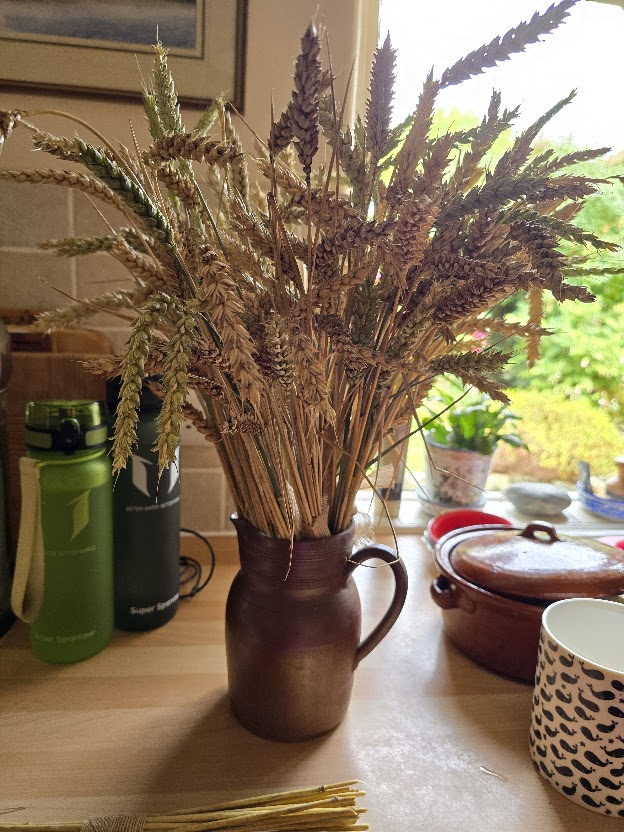
The Autumn Equinox has long been associated with harvest and thanksgiving. Yet before there can be gratitude, there first has to be receiving.
So much of what sustains us can arrive almost invisibly. We pick up an apple, slice a loaf of bread or prepare a meal without necessarily thinking about the soil, seed, rain, sunlight, insects, growers and countless relationships that have brought that food to our table.
There is nothing wrong with this — we cannot contemplate the origins of everything we touch! But when receiving becomes entirely unconscious, it is easy to begin taking what sustains us for granted.
Harvest invites us to notice.
And when we do, something changes. A simple meal can become evidence of an extraordinary web of relationship. We begin to recognise how much of our lives depends upon something beyond ourselves.
For me, this recognition can bring a sense of awe and wonder. The timing of the seasons, the abundance and diversity of life, the countless ways in which everything interconnects — when I stop long enough to notice, I can feel my inner world expand. I experience joy and the blessing of Life itself.
And perhaps most importantly, I remember: I am not separate from any of this. I am a part of it.
From that recognition, gratitude can arise quite naturally.
Gratitude can be deeply felt without ever being spoken or expressed. Yet I wonder whether something changes when we give gratitude a voice.
For me, simple practices of gratitude — particularly within my morning meditation — are a way of consciously acknowledging my relationship with something greater than myself. The practice may be familiar and repetitive, but that does not make it meaningless. It keeps a doorway open.
And in keeping the door ajar, we remain open to whatever may lie beyond it...
Seasonal thresholds such as the Equinox offer us an opportunity to give our gratitude greater attention: to gather, to create ritual, to sing, make sound, light a candle, prepare food or simply speak aloud what we are thankful for.
Gratitude felt is an inner experience. Gratitude expressed becomes relational.
We can recognise this in our human relationships too. Imagine continually giving to someone who may well feel grateful for what they receive, but rarely acknowledges, expresses or embodies that gratitude. Over time, giving can begin to feel expected and the relationship becomes unsustainable. The giver is left unseen, the receiver remains a passive recipient, and even the gift itself can begin to lose something of its value.
Acknowledgement matters. Appreciation, celebration, honouring and respect are ways in which we recognise not only the gift, but the giver and the relationship between us.
Perhaps this is one of the reasons our ancestors created harvest celebrations. Gratitude does not only need to be felt. It can be given expression — and once expressed, it begins to move between us.
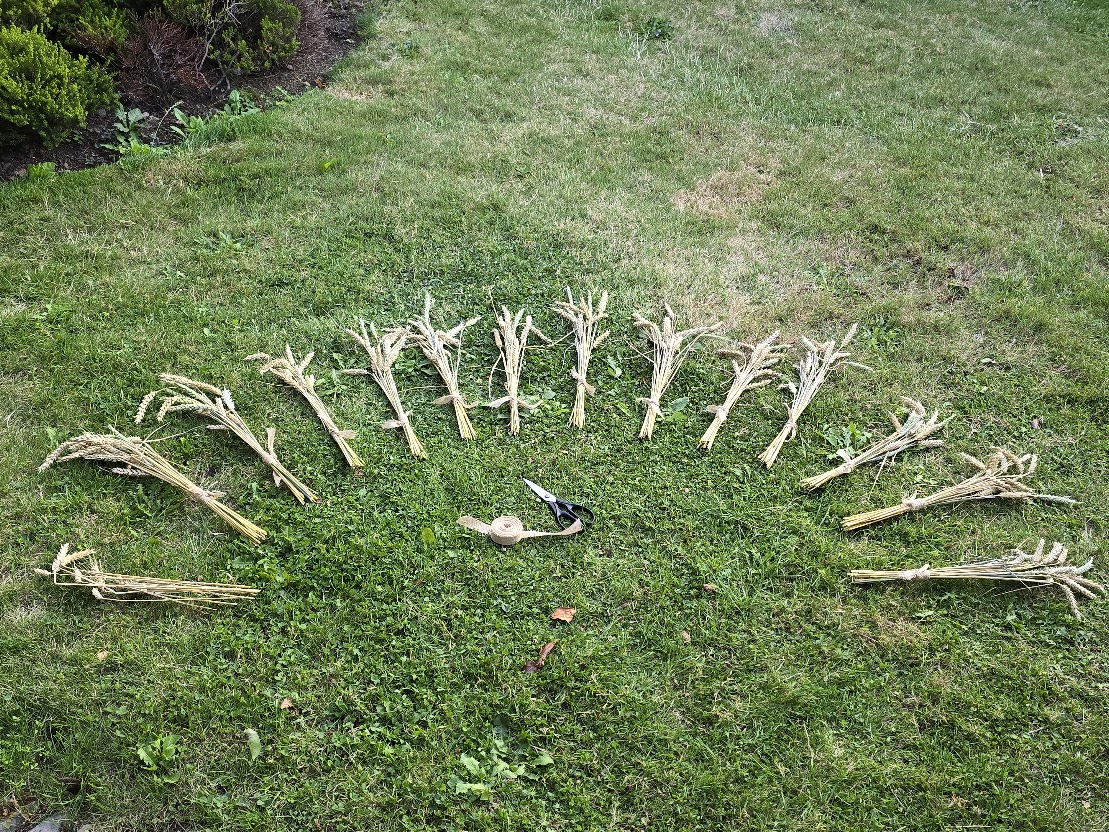
Last year, a friend gave me a small packet of ancient wheat seed. Our conversation had been about place and belonging, and she believed this particular variety would once have grown in the Basque region, where part of my own ancestry lies.
I planted the seeds and tended the wheat through the year. When harvest came, I gathered the stalks into small sheaves. Some travelled with me to Greece, where I offered wheat and the sound of my flute at the Temple of Poseidon. It was a very simple gesture, yet it became one of the most meaningful events of my year.
Other sheaves came with me to Sound-Well gatherings, where I invited people to receive them and, if they wished, make an offering of their own.
Perhaps you received one.
Perhaps it still rests somewhere in your home, or perhaps you offered it onwards. I know that one little sheaf still sits in the therapy room of a dear friend. What became of the others, I don't know — and I rather love that I don't know.
Because a gift does not necessarily need to be returned to the person who gave it.
The wheat came to me as a gift. I received it, planted it and tended it. The Earth received the seed and something grew. I harvested it and offered some onwards. Other people received it, and whatever meaning those little sheaves carried became theirs.
The gift continued to move.
Perhaps this is what offering can do. It gives gratitude an embodied expression — not as repayment or transaction, but as an act of honouring. What we receive can move through us, becoming generosity, care, creativity, tending, story, prayer, food, music — or another gift placed into someone else's hands.
We receive. We acknowledge. We offer. And the gift moves onwards.
"If our first response is gratitude, then our second is reciprocity: to give a gift in return." - Robin Wall Kimmerer, The Serviceberry
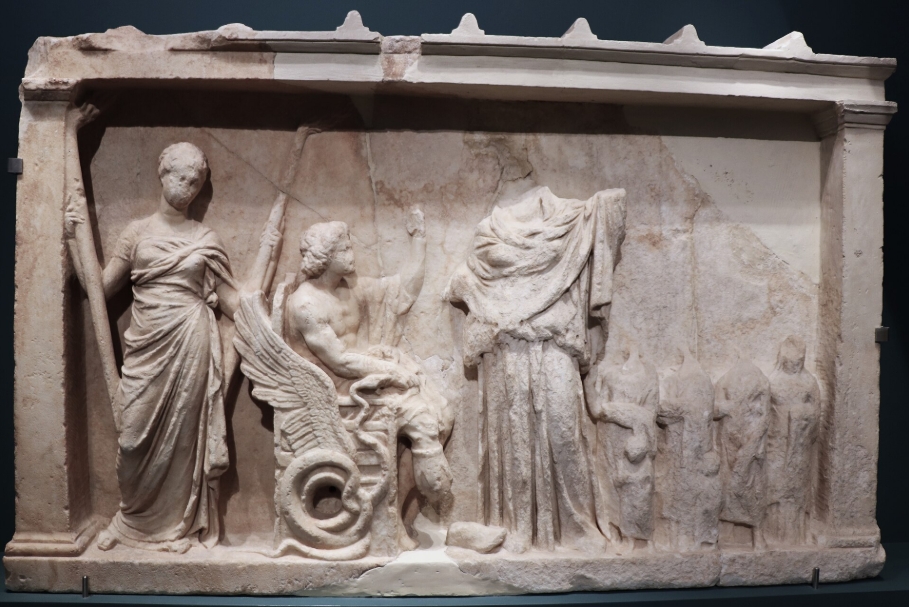
And this brings me back to Demeter.
In the ancient story, Persephone was abducted and taken into the Underworld by Hades, with the consent of Zeus but without the consent of either Persephone or her mother. Demeter heard her daughter's cry and searched for her for nine days, carrying torches, neither eating nor drinking. When she finally learned what had happened, her grief became something more.
Demeter withdrew from Olympus.
Eventually she took refuge in her temple at Eleusis and withheld her fertility from the Earth. Seed remained hidden. Nothing grew. Humanity faced famine.
And then something extraordinary happened.
Without the harvest, people could no longer make their customary offerings and sacrifices to the gods. The rupture did not affect Demeter and Persephone alone. It travelled through the whole web of relationship.
Zeus sent messengers. He offered Demeter gifts and honours. But she refused them.
There is something about this moment that moves me deeply. In a world in which powerful gods appeared able to take what they wanted, Demeter simply refused to acquiesce.
Her grief carried a quiet rage. Her No was not an attempt to overpower Zeus; she simply withdrew her participation from a relationship in which something fundamental had been violated.
And she stood her ground.
Acquiescence simply wasn't an option.
For me, this is Demeter's sacred defiance. Her refusal revealed something that could no longer be ignored: the harvest mattered, Demeter mattered, Persephone mattered — and relationship itself mattered.
The old order could not simply continue as though nothing had happened.
Zeus tried to appease Demeter with gifts and honours, but she would not be bought. His offers did nothing to address the rupture itself.
Appeasement simply restores the status quo. Genuine repair asks something more of us.
It asks us to look beneath the surface, towards the roots of a relationship, and to consider what needs to change for authentic healing to become possible.
I find myself wondering what this might mean for our own relationship with the Earth.
There are many things we can — and do — to reduce the harm we cause. We recycle, make greener choices, protect habitats and ask governments and businesses to act more responsibly. These things matter. But perhaps there is a deeper question beneath them:
What if the Earth is not simply something we live upon, use and care for, but something we are in relationship with?
In my heart, I recognise that we are interconnected within the great web of Life. Increasingly, I experience the Earth and some of her beings as part of a living family to which I also belong. My developing relationship with water has been a particularly powerful expression of this.
But recognising something and embodying it in everyday life are not necessarily the same thing. I am on this journey too. Remembering our interconnectedness, living it and learning what it means to be in right relationship is an ongoing practice — and one to which I aspire.
And perhaps genuine repair begins here — not with having all the answers, nor with trying to live a perfectly sustainable life, but with a willingness to reconsider the relationship itself.
We might begin very simply. An altar, a favourite tree, a candle, a bowl of water, a stone gathered on a walk — somewhere or something that helps us remember what we value and what we hold sacred.
Such gestures are not the repair itself. But they can help us practise a different way of relating.
And what we remember there can begin to influence how we live beyond it.
Perhaps this is where reciprocity becomes something more than simply giving back.
When we are in relationship, we listen and respond.
Sometimes Life offers something to us — a gift, an encounter, a moment of beauty, an unexpected kindness, perhaps even a challenge — and we choose how to respond.
At other times, we make the first gesture. We light the candle, make an offering, sing, speak, plant something, reach out to another — and in doing so, we open ourselves to relationship.
An offering can be an invitation.
We do not have to know what, if anything, will come in response. For me, this is less about belief and more about a willingness to enter the conversation: to remain curious, receptive and open to what might arise.
And perhaps there is no real beginning or end to this exchange. What I receive may inspire something I offer. What I offer may be received by another and become part of their own response. Their response may, in turn, offer something back to me — or move onwards into a life I will never see.
Reciprocity begins to feel less like a transaction and more like a living conversation.
We receive. We respond. We offer. We listen.
And relationship continues.
For many years, my Autumn Equinox reflections have included the familiar invitation to release and let go of that which no longer serves our highest good.
This year, I find myself asking a different question.
What might I be ready to entrust to the dark?
There is a subtle but important difference for me.
Letting go can suggest that something is finished: release it, leave it behind, move on. But not everything in our lives is ready to be released. Grief may not be ready. A relationship, an illness, a paradox, a dream or something we are still becoming may need something else from us — may still have something to offer us.
To entrust something is to hand it over with care.
The darkness of autumn need not only represent absence or loss. Beneath our feet, darkness holds soil, roots and seed. Within myth, it holds the mystery of the Underworld. Persephone descended into its depths. Inanna passed through the seven gates on her journey to the world below. And the ancient cycle of Venus — disappearing from sight and returning as morning or evening star — carries another image of disappearance, transformation and return.
Across these stories and cycles, darkness is not simply an ending. It can also be a place of incubation, gestation and transformation — a place where we cannot necessarily see what is happening.
Entrusting asks me to relinquish something I may never have truly possessed in the first place: control — or at least the illusion of it.
I can participate. I can show up, tend, listen, respond and care. But I cannot always determine what happens next.
Demeter could not undo what had happened to Persephone. Nor did Persephone return from the Underworld unchanged. In the ancient story, the pomegranate seed she had eaten bound her to return to the world below for part of each year. The maiden who had been taken there would also become its Queen.
Perhaps this is another wisdom the story offers us.
What we entrust to the dark may remain there. It may change. It may one day return — but not necessarily when we expect, in the form we expect, or as the thing we once knew.
And in the meantime, we too may change.
We can participate without controlling. We can care without knowing. We can entrust without abandoning.
"This is the art of the soul: to harvest your deeper life from all the seasons of your experience." John O'Donohue, Beauty
Perhaps this is what ritual can offer us: not an experience we can prescribe or manufacture, but a space in which something may be encountered.
We can pause. Listen. Give thanks. Make an offering. Entrust something to the dark. And then remain open to what arises — within ourselves, through another, through the living world, or through whatever we experience as something beyond ourselves.
The experience itself matters.
And it does not necessarily have to remain ours alone.
This Equinox, some of us will gather to make prayer flags — giving form to our gratitude, prayers and offerings before releasing them to the wind. Later in the autumn, there will be another invitation within the Sound-Well community to pause and acknowledge something from our own journey: through the recognition of a personal story within this year. It could be a discovery, an unexpected relationship, an experience, a miracle, or simply something that has felt meaningful to us.
Sometimes the simple act of acknowledgement matters: this happened; this mattered.
And when we choose to share something of our experience, another possibility opens. We can listen to one another, witness, celebrate, honour and receive.
For me, this is community embodied.
Something that has nourished me may become an offering to you. Something you share may awaken or nourish something in another. We cannot know where it will travel from there.
Just like those little sheaves of wheat.
The gift continues to move — through story, ritual, sound, prayer, relationship and community.
Perhaps this is where I find myself arriving this Autumn Equinox.
We know from our human relationships what it can feel like to give and give, while what we offer gradually becomes expected or taken for granted. The other person may genuinely feel grateful, but if that gratitude is never acknowledged, expressed or embodied, something within the relationship can begin to diminish.
The giver can become invisible. The gift itself can lose its value. And eventually, the giving may become unsustainable.
Demeter's story offers us a powerful image of what happens when the giving stops.
When she withheld the harvest, humanity discovered just how dependent it was upon her gifts. And without the harvest, there could be no offering in return. The fractured relationship was exposed.
Perhaps this is why gratitude feels increasingly important to me — not simply as a feeling, nor even as a practice, but as a gateway into relationship.
Gratitude asks us to notice what we have received. To acknowledge its source. To recognise its value. And from that recognition, we may find ourselves wanting to respond — through appreciation, celebration, care, generosity, offering or transformation.
Not because we owe a debt.
Because we are in relationship.
And so, as we stand at this seasonal threshold, perhaps the invitation is not simply to ask what we are ready to let go of.
We might also ask:
What have I received?
What deserves to be acknowledged, celebrated or honoured?
Where in my life might gratitude need to become more visible?
What might I offer in response?
And what am I ready to entrust to the dark?
Perhaps we do not need to know where any of this will lead.
We can simply begin by noticing the gift.


