
MENU
"And the secret garden bloomed and bloomed and every morning revealed new miracles." - Frances Hodgson Burnett
There are some things in life that reveal their meaning slowly.
Fifteen years ago, I took on an allotment in Dunster.
To this day, I would hesitate to describe myself as a natural gardener. Quite the opposite. Growing things has never come easily to me. More often than not, I have felt resistance when faced with the endless jobs an allotment seems to generate. There have been times when it felt overwhelming and times when I wondered whether it might be easier to let it go altogether.
And yet, through all those years, I never truly wanted to.
Something in me wanted to keep it. Something in me knew it held meaning and value. I didn't fully understand why, but I listened.
In retrospect, I realise this has become something of a pattern in my life. Sometimes meaning arrives before understanding. It was like that with the gongs, and I often refer to it as "following the breadcrumbs". Sometimes we feel a call and don't know why. Sometimes we are asked to remain in relationship with something long before we understand what it is trying to teach us.
Last year, it was wheat.
I'd been exploring my Basque ancestral roots when a friend gave me a bag of an ancient wheat variety, most likely one that would have been grown in northern Spain hundreds of years ago. There was something deeply satisfying about scattering the seed at the Spring Equinox, watching it grow, harvesting it by hand at the September Full Moon, and offering small bundles to others for their altars and celebrations of abundance. The meaning arrived gradually through participation.
This year, it is the Rose.
A few years ago, I found myself increasingly drawn to the Rose through story, myth and symbol. I wrote about the Rose of Venus — the beautiful pattern Venus traces through the heavens over an eight-year cycle. The Rose seemed to appear wherever I turned: in sacred geometry, spiritual traditions, poetry and art.
At first, the Rose was an archetype. A symbol. A doorway.
Then, one early March morning, six bare-root Damask roses arrived.
I had a vision of fresh roses on my altar and perhaps, one day, rose oil made from their petals. I loved their fragrance, their history, and their long association with the human heart. Inspired by those possibilities, I set about planting them.
What I remember most vividly now is not the vision but the digging.
Six deep holes. One for each rose and its gnarled woody roots, which needed plenty of room to breathe.
The ground was heavy and the work harder than I had anticipated. Looking at those bare-root plants, little more than sticks emerging from freshly turned earth, there was no obvious sign of the abundance that would follow.
And yet something in me felt certain enough to continue.
So I dug. And planted. And watered. And waited.
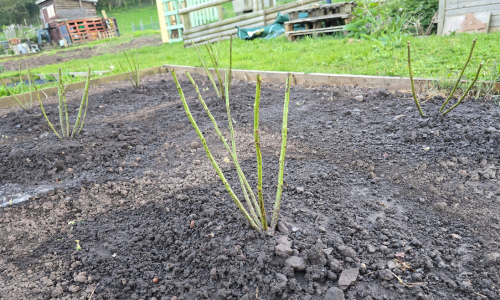
Looking at that photograph now, it is hard to believe that those six bare-root plants would one day fill baskets with fragrant blooms.
And yet, a little over a year later, that is exactly what happened.
This spring and early summer, the roses have flowered with an abundance that has taken me completely by surprise. Every morning seems to bring new blooms. Some days I wander up to the allotment and return home carrying a basketful of soft pink flowers.
As I write this, trays of Damask rose petals are drying gently. Glass jars are slowly filling with what look like tiny pink jewels. The first rose oil infusions are beginning. More petals wait patiently to be gathered.
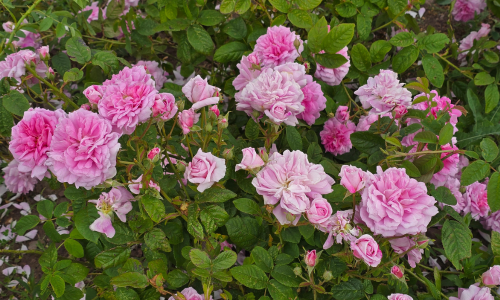
There is something deeply satisfying about participating in the entire process. Not purchasing rose petals or buying rose oil, but growing, gathering, drying and preparing them by hand.
The Rose has invited me into relationship and, somewhere along the way, something shifted. What had once been a symbol became a companion; a teacher, muse, mother and guide.
For years I had encountered the Rose through stories, sacred traditions and spiritual symbolism. I was fascinated by its association with the heart, beauty, devotion and the feminine. The Rose appeared in poetry, mythology and sacred art.
But symbols live largely in the imagination. Relationships ask something more of us. They require presence, participation, patience and attention.
The Rose no longer lived only in books or stories.
She was growing in the soil beneath my feet.
And as I harvested petals beneath the early summer sun, I found myself wondering whether the Rose had been teaching me all along.
Perhaps that is why this year's rose harvest has brought me such deep joy. It has touched me more deeply than I expected.
On the surface, it is simply a flower: beautiful, fragrant, ancient and beloved by poets, mystics and gardeners alike. Yet beneath that beauty, I sense something else.
A teaching.
The Rose asks nothing of me except relationship. It does not hurry or strive. It does not bloom in winter because it wishes it were summer. It responds to season, weather, soil, sunlight and rain. It participates fully in the life it has been given and, in doing so, becomes exactly what it was always intended to be.
The seventeenth-century mystic Angelus Silesius wrote:
"The rose is without why; it blooms because it blooms."
There is something about those words that feels both beautiful and challenging. The Rose does not bloom in order to prove its worth. It does not bloom because it has finally achieved something. It blooms because blooming is its nature.
How different this is from the way many of us have been taught to live.
So often we are encouraged to strive for outcomes, achievements and destinations. We are taught to focus on what comes next, what still needs fixing, improving or accomplishing.
The Rose offers another possibility. It invites us to become more deeply rooted in what is already here, to tend what is in front of us, to participate in our lives rather than rush through them, and to trust that not everything needs to be forced.
Some things unfold in their own time.
Looking back, I realise this is what the allotment has been teaching me all along: not gardening so much as relationship; not productivity, but participation; not certainty, but trust.
The wheat taught me something about cycles.
The Rose is teaching me something about belonging.
As I write this, fresh roses from the allotment sit on my altar beside last year's wheat harvest. Looking at them together, I am reminded that the conversation continues. One taught me something about cycles; the other is teaching me something about belonging.
For years, I thought I was drawn to the Rose because of all it seemed to represent: the heart, beauty, devotion, and its enduring presence in myth, poetry and sacred art. Perhaps all of that is true.
But now I wonder whether something deeper was happening.
Perhaps the Rose was quietly calling me into relationship, inviting me to move beyond ideas and into experience, beyond symbolism and into participation, beyond admiration and into belonging.
As I reflect on these roses, I find myself wondering where else this teaching might apply.
What in my own life is quietly flourishing because I have stayed in relationship with it?
What has revealed its meaning only through time, patience and participation?
The allotment is one answer, the gongs another, and The Spiral Home itself may be another still. Each began with a feeling, a nudge, a breadcrumb. None arrived with a detailed map, and yet each has unfolded into something richer than I could have imagined at the beginning.
Perhaps that is why I find myself returning again and again to the image of roots and blossoms.
The Rose does not choose between earth and sky. Its roots reach down into the dark richness of the soil while its flowers open towards the light. Both are necessary. Neither can exist without the other.
And perhaps we are not so different.
We are asked to live rooted in the realities of everyday life whilst remaining open to beauty, wonder, mystery and possibility.
The heart, it seems to me, is the meeting place. The place where two worlds overlap and a new space opens between them. The place where earth and heaven touch. The place where the visible and invisible meet. The place where relationship becomes transformation.
As I write this, the roses continue to bloom. More petals are waiting to be gathered. Three jars of rose oil are quietly beginning their slow infusion. The story continues...
And perhaps that is the final gift the Rose has offered me this year: the understanding that life is not something we conquer, solve or complete. It is something we enter into relationship with, something we tend, something we participate in, something we belong to.
As midsummer approaches, I find myself sitting with a simple question:
Where are you being invited to trust the unfolding rather than rush towards an outcome?
Perhaps the answer is already in some roots.
And perhaps, in its own time, it will flower.


