
MENU

The journey through our seven chakras brings us now to the Solar Plexus, the third chakra, traditionally associated with the element of fire.
Having explored our foundations of safety, stability and belonging through the Root Chakra, and the world of feeling, pleasure, creativity and relationship through the Sacral Chakra, we arrive at another aspect of our human experience: our developing sense of self.
Who am I? What do I believe? What do I want? And how do I choose to live?
These questions bring us into the territory of personal power — our capacity to act, make decisions, establish boundaries and take responsibility for the lives we are creating.
Yet personal power is not simply about making things happen. It is also about how we respond when life unfolds differently from what we had imagined.
The Sanskrit name Manipura is commonly translated as 'City of Jewels' or 'Jewel City', evoking something precious, luminous and radiant within us.
Situated in the region of the navel and upper abdomen, Manipura is traditionally associated with fire and the transformative processes of digestion and assimilation.
In the familiar modern seven-chakra system, its principal characteristics include:
In traditional symbolism, the ram is associated with the fire element, while contemporary chakra interpretations also draw upon the Sun, Mars and the imagery of the warrior.
Fire has the capacity to warm, illuminate, nourish and transform. It can also burn fiercely, consuming whatever lies in its path.
The invitation is not to extinguish our inner fire, nor to allow it to rage unchecked, but to develop a conscious relationship with its power.
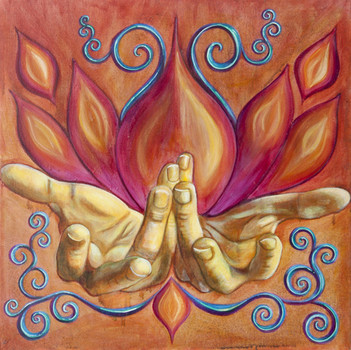
There are two important expressions of personal power.
The first is our capacity to act: to initiate, create, make decisions, establish boundaries and bring our intentions into being.
The second is our capacity to respond: to remain connected with ourselves when circumstances are beyond our control, and to choose how we meet them.
Both matter.
Yet responding is not the same as reacting.
Many of our reactions arise from unconscious patterns established early in life. We may have learned to defend ourselves, seek approval, withdraw, appease others or attempt to control situations in order to feel safe.
These responses may once have served us well. But when they become automatic, we can find ourselves repeating patterns that no longer reflect who we are or how we wish to live.
And sometimes, in the very act of reacting, we give away the power we are trying to protect.
Becoming aware of these patterns offers another possibility.
We can recognise anger without being governed by it. We can experience fear without allowing it to make every decision. We can acknowledge an old wound without assuming that the present moment must unfold in the same way as the past.
This is not about suppressing our feelings. It is about creating the freedom to choose what we do with them.
When something provokes us, are we responding to what is happening now, or reacting from the person we once needed to be?
The ego is often spoken of as something we must overcome. Yet a healthy sense of individuality is essential to our ability to navigate the world.
We need to recognise ourselves as distinct individuals, with our own needs, preferences, beliefs and boundaries.
Our sense of self begins developing in childhood, shaped not only by our emerging independence but also by the relationships and environments in which we grow.
We may learn that we are valued for our achievements, our helpfulness, our obedience or our ability to meet the expectations of others.
Cultural and moral conditioning, family expectations and inherited beliefs may also influence how we understand ourselves and our place in the world.
Over time, these experiences can become part of the story we tell ourselves about who we are.
But the beliefs we inherit are not necessarily the truths by which we must continue to live.
A mature relationship with our ego allows us to recognise our individuality without constantly needing to defend or prove it.
We can be confident without needing to dominate, strong without becoming rigid, and independent without losing our capacity for connection.

Manipura is traditionally associated with the transformative power of fire, including the processes of digestion and assimilation.
Our bodies take in food, break it down and transform it into nourishment and energy.
We might recognise a similar process in our emotional and psychological lives.
Throughout our lives, we absorb experiences, beliefs, expectations and stories. Some nourish us. Others may constrain our understanding of ourselves.
Our inner fire offers a metaphor for the capacity to examine these experiences, discover what they have to teach us and transform understanding into wisdom.
We needn't reject our past in order to become free of its limitations.
We can learn to digest it.
And in doing so, we may discover that personal power is not something we must continually strive to acquire. It can emerge through a growing awareness of who we are and the freedom we have to choose.
Every choice sets something in motion.
Sometimes the consequences are what we hoped for. Sometimes they surprise, disappoint or challenge us.
Taking responsibility for our choices, and for their consequences, is part of how we learn and evolve.
Responsibility is not the same as blame. Nor does it mean accepting responsibility for the actions of others or for circumstances beyond our control.
It means acknowledging our own participation in life, recognising the impact of our decisions and allowing experience to deepen our understanding.
We cannot control everything that happens to us.
But we can cultivate the awareness, courage and discernment to participate more consciously in what happens next.
And perhaps this is one of the greatest gifts of Manipura: discovering that our power need not be measured by our ability to control life, but by our willingness to inhabit it fully.
As we recognised in the original article, we are in a partnership with life. We can bring our intention, effort and commitment, while acknowledging that the outcome is never entirely ours to determine.

Within contemporary chakra practice, an imbalance in Manipura is often described in terms of our relationship with confidence, will and personal power.
When these qualities feel diminished, we might experience self-doubt, difficulty making decisions, a tendency to seek approval, reluctance to establish boundaries or discomfort with our own independence.
At other times, we may notice excessive striving, perfectionism, impatience, defensiveness, anger or a need to control our circumstances and the people around us.
We may measure our worth through achievement, or become so concerned with getting things right that we lose the pleasure of participating in life.
These experiences do not necessarily indicate an energetic imbalance. They are opportunities for reflection through the symbolic lens of the Solar Plexus Chakra.
Similarly, although Manipura is traditionally associated with digestion, digestive problems and other physical symptoms should not be assumed to arise from chakra imbalances.
The intention is not to judge ourselves, but to become curious about how we use our energy and where we may be acting from habit rather than conscious choice.
There are many ways to explore and nourish the qualities associated with Manipura.
Movement and breath
Yoga postures such as Cow Pose, Seated Spinal Twist and Camel Pose can encourage movement and awareness through the torso, when practised comfortably and with appropriate guidance.
Gentle breathing practices, particularly allowing the exhalation to soften, may also help us become more aware of tension and relaxation.
The element of fire
Spending time in sunlight, sitting safely beside a fire or contemplating the steady flame of a candle offers opportunities to reflect upon warmth, vitality and transformation.
Colour and nourishment
Yellow and gold are traditionally associated with the Solar Plexus in modern chakra practice.
Foods such as bananas, pineapple, corn, lemons and golden spices may be enjoyed as symbolic connections with this colour, rather than as treatments for chakra imbalances.
Aromatherapy and gemstones
Bergamot, geranium and clary sage are among the essential oils associated with Manipura in contemporary holistic practice.
Citrine, yellow jasper, lemon quartz and amber are also commonly used as symbolic companions for reflection and meditation.
Amber, formed from fossilised tree resin, has a particularly beautiful relationship with the imagery of sunlight, warmth and the ancient Earth.
Awareness and affirmation
Perhaps the most valuable practice is noticing those moments when we feel compelled to react, and discovering whether another response is available.
We might explore affirmations such as:
I trust myself to choose.
I can act with courage and respond with awareness.
I take responsibility for my choices and remain open to learning.
My strength arises from within.
These are not statements we need to force ourselves to believe, but possibilities we can gently explore.
Sound offers another way of exploring our relationship with ourselves.
In traditional chakra practices, the seed mantra associated with Manipura is RAM, which may be sounded aloud as part of meditation.
Within my own work as a Healing Sound Practitioner, the resonant sounds and vibrations of the gongs offer an opportunity to rest, listen and turn our attention inward.
Thw gong I associate with the Solar Plexus is the Sun Gong. It's distinctive voice offers different qualities within the soundscape, inviting us to experience resonance, movement and stillness.
Rather than striving to achieve a particular state, we can allow ourselves to experience what is present.
Perhaps we notice tension, warmth, resistance, ease or a growing sense of spaciousness.
There is nothing we need to force.
We are simply invited to listen.
Our online chakra journey continues next week with the Solar Plexus Sound Bath, offering time and space to explore the qualities of Manipura through sound, stillness and reflection.
Whether joining live or listening to a recording afterwards, you are warmly invited to experience this next stage of the journey.
To prepare, find somewhere quiet and comfortable where you can sit or lie down undisturbed. Have headphones or speakers ready, together with a blanket, pillow, eye mask and anything else that will help you feel warm, cosy and supported.
To book your spot, visit: Sound-Well's Events and Booking Page Select the event of your choice and follow the booking process.
I accidentally found Sound-Well while searching for other events and thought: "Why not give it a shot?!" And I'm so happy I did. It's the most calming and relaxing experience I've had so far and Alexandra does wonderful work. I nearly join her Gong sessions weekly and can highly recommend it. Andrea
Perhaps our greatest power is not something we need to prove.
It is something we can learn to inhabit.


