
MENU
The chakras are traditionally understood as energy centres within the subtle body, each associated with different aspects of our physical, emotional and spiritual experience.
Beginning at the base of the spine and moving upwards through the body, the seven main chakras offer us a way of exploring our relationship with ourselves and with the world around us. Rather than existing independently, they can be understood as interconnected — each influencing and supporting the others as we move through life.
Having begun with the Root Chakra and our foundations of grounding, safety and belonging, we now move upwards into the Sacral Chakra — traditionally associated with the element of water and with feeling, creativity, sensuality, pleasure, desire and our capacity to flow with life.
If the Root Chakra asks, “Am I safe enough to be here?”, perhaps the Sacral Chakra asks something different:
“Can I allow myself to feel and experience being fully alive?”

This is the realm of our emotional life — not simply whether we experience emotion, but how willing and able we are to be present with what we feel. Can we allow sadness, joy, anger, tenderness, longing or delight to move through us without immediately judging, suppressing or becoming overwhelmed by them?
The Sacral Chakra also invites us into relationship with pleasure and the senses: with touch, taste, scent, movement, beauty, creativity and those experiences that bring us enjoyment and make us feel alive.
Pleasure is not an indulgence to be earned. Our capacity to notice what feels good, to receive it and to allow ourselves to enjoy it can be an important part of our wellbeing.
And neither emotion nor desire necessarily needs to dictate what we do. Sometimes the first invitation is simply to notice:
This is what I feel.
This is what I desire.
Can I stay present with it long enough to listen?
The Sacral Chakra is the second of the seven main chakras. Its Sanskrit name is Svadhisthana (also written Swadhisthana), commonly translated as “one's own dwelling place” or “where the self is established.”
Located in the lower abdomen and pelvic area, below the navel, it is traditionally represented by the colour orange and associated with the element of water.
And water is a beautiful way to begin understanding the nature of this chakra.
Water moves. It responds. It can be still or turbulent, powerful or gentle. It takes the shape of what holds it without ceasing to be water. Our emotional lives have something of this same quality: feelings arise, change and move through us. Difficulties can occur when we try to dam that movement completely — or when we feel swept away by it.
The Sacral Chakra invites us to develop a more conscious relationship with this inner flow.
It is associated with:
Rather than thinking of a “balanced” Sacral Chakra as one in which we are always calm, happy or emotionally steady, perhaps it is more helpful to think about capacity: our capacity to feel, to experience pleasure, to respond to change, to create, to connect and to remain present with ourselves as life moves through us.
As the close neighbour of the Muladhara, or Root Chakra, the Sacral Chakra builds upon the foundations of safety, grounding and belonging explored in the first chakra. Once there is enough safety to be here, we can begin to open more fully to the experience of being here — to feel, respond, create, connect and engage with what life brings us.
The Sacral Chakra invites us to meet what emerges through our emotional awareness and intelligence, developing our capacity to respond creatively rather than simply react.
Root — I am here.
Sacral — I feel.
Our emotions are part of the way we experience and make sense of being alive. They can alert us to what matters, what hurts, what delights us, what frightens us, what we long for and where something may need our attention.
Yet many of us learn, consciously or unconsciously, that some feelings are more acceptable than others. We may become accustomed to suppressing anger, hiding sadness, minimising excitement or dismissing our own emotional responses before we have really had an opportunity to understand them.
At other times, an emotion can feel so powerful that we become caught up in it, unable to distinguish between what I am feeling and who I am.

Working with the Sacral Chakra offers another possibility: learning to stay present with what we feel.
This doesn't mean indulging every emotion or allowing it to determine our actions. Nor does it mean trying to control or transcend what arises. Instead, we can begin by becoming a compassionate witness to our own experience.
What am I feeling?
Where do I feel it in my body?
Can I allow this to be here without immediately needing to change it, explain it or take it somewhere else?
There can be something profoundly supportive in being witnessed by another person. We need relationship, connection and places where we can safely share ourselves. But we can also learn to become our own first witness — meeting what arises within us with curiosity, tenderness and compassion before looking outside ourselves for reassurance, interpretation or permission.
In this way, emotional awareness can become part of our inner guidance. We do not have to suppress what we feel, and neither do we have to become possessed by it.
We can feel.
We can listen.
And then, from a more grounded place, we can choose how we wish to respond.
The Sacral Chakra is also associated with our capacity for pleasure — with our ability not only to encounter enjoyable experiences, but to recognise them, receive them and allow ourselves to be nourished by them.
Pleasure can be wonderfully simple. Warmth on our skin. The taste of something delicious. Moving our body in a way that feels good. Music that reaches somewhere deep inside us. The scent of rain or flowers. Laughter. Touch. Colour. Beauty. The delicious sensation of slipping into warm water — or the exhilaration of cold!
Our sensuality is part of this. At its broadest, sensuality is simply our capacity to experience life through our senses: to see, hear, taste, smell and touch, and to notice how those experiences affect us.
Sexuality can be an expression of our sensual nature, but sensuality belongs to all of us and reaches far beyond sex. It is one of the ways we inhabit our bodies and experience ourselves as fully alive.
And then there is desire.
Desire can sometimes make us uncomfortable. We may have learned that wanting something is selfish, excessive or somehow less spiritual than being content with what we already have. Yet desire can also carry valuable information.
What do I want?
What am I drawn towards?
What brings me alive?
Listening to desire does not mean that every desire must be acted upon or fulfilled. Just as we can witness an emotion without being ruled by it, we can become curious about desire without becoming driven by it.
There is an important difference between receiving pleasure and grasping after it. When we are truly present to a pleasurable experience, we may discover that we don't need to possess it or prolong it for it to have nourished us. We can allow ourselves to receive what is here, enjoy it fully, and eventually let it pass.
Perhaps this is one of the gifts of working consciously with the Sacral Chakra: increasing our capacity not only to hold difficult feelings with compassion, but also to receive joy, pleasure, beauty and delight without shrinking away from them.
And sometimes the practice can be beautifully simple:
This feels good.
Can I let myself receive it?

Creativity is another important expression of the Sacral Chakra. And creativity does not belong only to those who consider themselves artists.
Whenever we imagine, experiment, make, adapt or find a new response to something life presents us with, we are engaging our creative capacity. We might express this through painting, writing, music, dance, cooking or making something with our hands, but equally through the way we solve a problem, shape a home, tend a garden or imagine a different possibility for our lives.
Like water, creativity needs some freedom to move.
When we become overly concerned with getting something right, pleasing others or knowing exactly where something will lead before we begin, that natural movement can become restricted. Sometimes creativity asks us simply to play, explore and discover what happens.
The Sacral Chakra is also closely associated with relationship and intimacy. As we become more aware of our own feelings, desires and boundaries, we become better able to meet another person without losing ourselves within the relationship.
This does not mean becoming entirely self-contained. Healthy relationship involves exchange — giving and receiving, listening and being heard, reaching towards another and allowing ourselves to be reached.
Perhaps this is another expression of flow.
Water teaches us that movement does not require us to lose our essential nature. We can respond, adapt and change while remaining ourselves.
And so the Sacral Chakra invites us to notice:
Where in my life do I feel able to flow?
Where might I be holding myself too tightly?
Where am I being invited to create, connect, play or experience something differently?
There may be times when we feel disconnected from some of the qualities traditionally associated with the Sacral Chakra.
Perhaps we find it difficult to know what we are feeling, or have become accustomed to pushing emotions aside in order to carry on. We may feel emotionally numb, creatively stuck or disconnected from pleasure and enjoyment.
At other times, the opposite may seem true. Feelings can become overwhelming, relationships consuming, or we may find ourselves continually reaching for something outside ourselves to soothe, distract or make us feel better.
Neither experience means that there is something wrong with us.
Our relationship with emotion, pleasure, intimacy and desire is shaped by many things: our upbringing, relationships, culture, experiences and the messages we have received about what it is acceptable to feel, want or express.
Sometimes what appears to be a difficulty with feeling may once have been a very intelligent way of protecting ourselves.
Rather than asking, “Is my Sacral Chakra blocked?”, we might therefore ask:
What is my relationship with feeling?
Can I recognise what I am feeling without judging myself for it?
Can I experience pleasure without guilt — and without needing to grasp for more?
Can I recognise and honour my desires while still choosing how I respond to them?
Can I allow myself to play, create and enjoy?
Can I remain connected with myself while being emotionally close to another?
And perhaps most importantly:
Can I meet whatever I discover with curiosity and compassion?
Working with the Sacral Chakra need not be about fixing ourselves. It can simply be an invitation to notice where greater freedom, movement and flow might be possible.
Because the Sacral Chakra is traditionally associated with water, movement, feeling and the senses, some of the simplest ways of exploring it are through the body and through our everyday experience.
Water can be a particularly lovely companion. Swimming, bathing, walking beside a river or the sea, listening to rain, or simply taking time to notice the sensation of water on our skin can invite us back into a more fluid, sensory relationship with ourselves.
Movement can offer something similar. This doesn't have to mean formal exercise or yoga. Stretching, walking, dancing around the kitchen or allowing the body to move intuitively to music can help us notice where we feel free and where we may be holding ourselves tightly.
And then there is pleasure.
We might consciously give ourselves permission to savour something we enjoy: the taste and texture of food, the warmth of sunlight, a beautiful scent, soft fabric against the skin, music, colour, touch, laughter or rest.
The practice is not necessarily to seek more pleasure, but to become more present to the pleasure that is already available to us.
Creativity can also be explored without needing to produce anything of value. Paint. Write. Sing. Cook. Garden. Make something. Play. Follow curiosity without needing to know where it will lead.
And we can make space for our emotional lives too. Journalling, meditation, quiet reflection or simply pausing when something arises can help us become more familiar with what we are feeling before deciding what, if anything, we want to do about it.
For some of us, this may also mean gently noticing where shame appears — particularly around pleasure, desire, sensuality, creativity or emotional expression.
Rather than trying to push shame away, we might become curious about it:
Whose voice am I hearing?
What have I learned about what I am allowed to feel, want or enjoy?
Does that belief still belong to me?
The colour traditionally associated with the Sacral Chakra is orange, and some people enjoy consciously bringing orange foods, flowers, clothing, candles or other objects into their surroundings when working with this chakra. Crystals commonly associated with the Sacral Chakra include carnelian and orange calcite, while its traditional seed sound, or bija mantra, is VAM.
None of these practices needs to become another thing we should be doing. Choose what appeals to you. Notice what awakens your curiosity or gives you a sense of aliveness.
Sometimes working with the Sacral Chakra might begin with nothing more complicated than asking:
What would feel nourishing or pleasurable to me today — and can I allow myself to receive a little of it?
Sound offers another way of exploring the chakra system — not simply through ideas, but through our felt experience of vibration, resonance and listening.
The traditional bija, or seed sound, associated with the Sacral Chakra is VAM. Within Tantric chakra traditions, this syllable is associated with Svadhisthana and its element of water, and can be sounded aloud or used inwardly as part of meditation and contemplative practice.
You may also come across 417 Hz described as the frequency of the Sacral Chakra. This association belongs to the much more recent system commonly known as the Solfeggio frequencies, rather than to the older yogic chakra traditions. Within contemporary sound-healing practice, 417 Hz has become associated with change, movement and the Sacral Chakra.
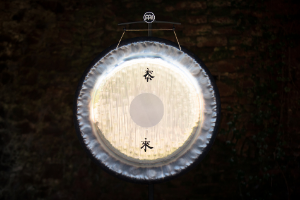
In my own work with gongs, however, I am less interested in suggesting that there is one particular frequency that can somehow “fix” or “reset” a chakra.
What interests me is the experience of sound itself.
A gong creates layers of vibration, tone and resonance that are continually changing. We can listen without needing to analyse or understand what we are hearing, allowing our attention to move instead towards sensation, breath, feeling and whatever else may be arising within us.
For the Sacral Chakra in particular, this can become an invitation into listening and receiving.
What happens when we don't need to do anything?
When we allow sound to move around and through us?
When we become curious about what we feel?
In this sense, sound can become another form of self-witnessing — an opportunity to be present with our own experience without immediately needing to change it.
And perhaps that is particularly appropriate for a chakra associated with water.
We listen.
We receive.
We notice what moves.
David Pond, in Chakras for Beginners, writes:
“The skill of learning how to enter into the sensation of enjoyment is required. To experience pleasure is one thing, but to recognize the experience as enjoyable and then enter into the felt sense of appreciation of the moment — now that is an art.”
I love this distinction.
We can encounter something pleasurable without necessarily allowing ourselves to fully receive it. Our attention may already be moving towards the next thing, our minds may be elsewhere, or some part of us may feel uncomfortable simply allowing ourselves to enjoy what is happening.
Perhaps working with the Sacral Chakra asks us to linger a little longer.
To notice the warmth of the sun.
To taste the food.
To feel the water.
To listen to the music.
To recognise when something delights us.
And to allow ourselves to say, without apology:
I enjoy this.
On Tuesday 20 October, our journey through the seven chakras continues with an online Sacral Chakra Sound Bath.
Having begun with the grounding and belonging of the Root Chakra, we will move into the fluid world of Svadhisthana — exploring feeling, pleasure, sensuality, creativity and flow through meditation, reflection and sound.
You can join this session individually, or as part of the complete 7-Chakra Journey through to the Winter Solstice.
And whether or not you join me, perhaps you might take one question from this exploration with you:
What helps me feel fully alive — and how willing am I to receive it?
Because perhaps the invitation of the Sacral Chakra is not to become more emotional, more creative, more sensual or more anything.
Perhaps it is simply to become more available to our own experience.
To feel what we feel.
To notice what we desire.
To receive what nourishes us.
To listen to what moves within us.
And from there, to allow life to move through us with a little more freedom and flow.
If you would like to receive Sound-Well's latest blogs, news, events and offers sign up to our newsletter at: Sound-Well (list-manage.com)


